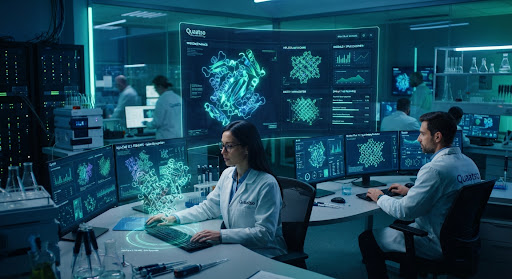
Quantum computers get the headlines, but quantum sensors are already at work all around you, and the next generation could change navigation, medicine and mining.
What quantum sensing is
Quantum systems are extremely sensitive to their surroundings. For computing that is a problem, but for measurement it is a gift. Quantum sensors use that sensitivity to measure time, magnetic fields, gravity and motion with remarkable precision.
Atomic clocks: the quiet success story
Since 1967, the official second has been defined using atoms: it is the time taken for 9,192,631,770 oscillations of radiation linked to a particular quantum transition in the caesium-133 atom. Atomic clocks based on this effect keep the world’s time.
GPS satellites carry atomic clocks. Your phone works out where you are by comparing the timing of signals from several satellites. Light travels about 30 centimetres in a billionth of a second, so tiny timing errors would quickly become large position errors.
In medicine
MRI scanners rely on a quantum property of atomic nuclei called spin. Brain scanners known as MEG use extremely sensitive quantum magnetic sensors to detect the tiny magnetic signals produced by brain activity. Newer, wearable versions use sensors called optically pumped magnetometers, which don’t need extreme cooling.
Emerging applications
- ◆Navigation without GPS: quantum accelerometers and gyroscopes could help ships, aircraft and submarines navigate when satellite signals are blocked or jammed.
- ◆Seeing underground: quantum gravity sensors can detect small differences in density, helping find pipes, tunnels or mineral deposits without digging.
- ◆Better microscopes: tiny defects in diamond, called nitrogen-vacancy centres, can map magnetic fields at the scale of single cells.
- ◆Gravitational waves: the LIGO observatories use specially prepared “squeezed” light to reduce quantum noise and detect ripples in space-time.
Why it matters for business
Quantum sensing is closer to widespread commercial use than quantum computing, because it doesn’t need thousands of near-perfect qubits: a single well-controlled quantum system can be enough. Energy, defence, healthcare, mining and infrastructure are among the sectors watching most closely.
task_altKey takeaways
- check_circleAtomic clocks, which define the second and power GPS, are quantum sensors.
- check_circleMRI and MEG brain scanners rely on quantum effects.
- check_circleQuantum navigation and gravity sensing are promising emerging uses.